
Henderson Projected Versus Actual Release
TDCJ uses three labels that must stay separate. Maximum Sentence Date is when the controlling sentence expires under the record calculation. Projected Release Date is the agency's current statutory projection. Scheduled Release Date is an operational date posted after an approved release has moved through audit and planning. None should be rewritten as “released on” before a post-event status, release certificate, or official history confirms departure.
A person at Henderson County Jail before trial has no ordinary sentence-based projection. Bond may be posted, a court may change the order, a detainer may block departure, or another agency may receive the person. For a county sentence, the jail and judgment control. For a prison sentence, TDCJ records control. Leaving the county roster can also mean transfer to TDCJ, not release to the community.
| Date label | Meaning |
|---|---|
| Parole Eligibility Date | First possible consideration point under the applicable law, not a promise |
| Projected Release Date | Current TDCJ calculation based on the governing branch |
| Scheduled Release Date | Operational target after approval and records work |
| Maximum Sentence Date | Sentence expiration under the controlling calculation |
| Actual Release Date | Confirmed physical departure shown by a post-event record |
Find a Henderson Release Date
Begin with the custody system. The TDCJ Online Offender Search accepts a TDCJ number, SID number, or name. Name-only matches require care, so compare date of birth, conviction county, offense, and location before reading dates. Henderson County's county jail does not publish a verified person-level release-date feed.
- Confirm whether the person is in Henderson County Jail, a TDCJ unit, or another agency's custody.
- For TDCJ, search by the strongest identifier and open the matching detail.
- Record every label exactly: eligibility, projected, scheduled, maximum, last board action, and location.
- For county jail custody, call 903-677-6322 and search the court case for bond, judgment, or other order.
- If the jail record is unclear, request the booking and release record through county GovQA.
- After the expected date, check the status again and obtain actual-release evidence.
The Henderson County release-record workflow supplies the county records-request and judicial routes. A narrow request should identify the person, booking number if known, date range, and fields needed to show release time, disposition, and destination.
The official state search form is shown in the TDCJ source capture.
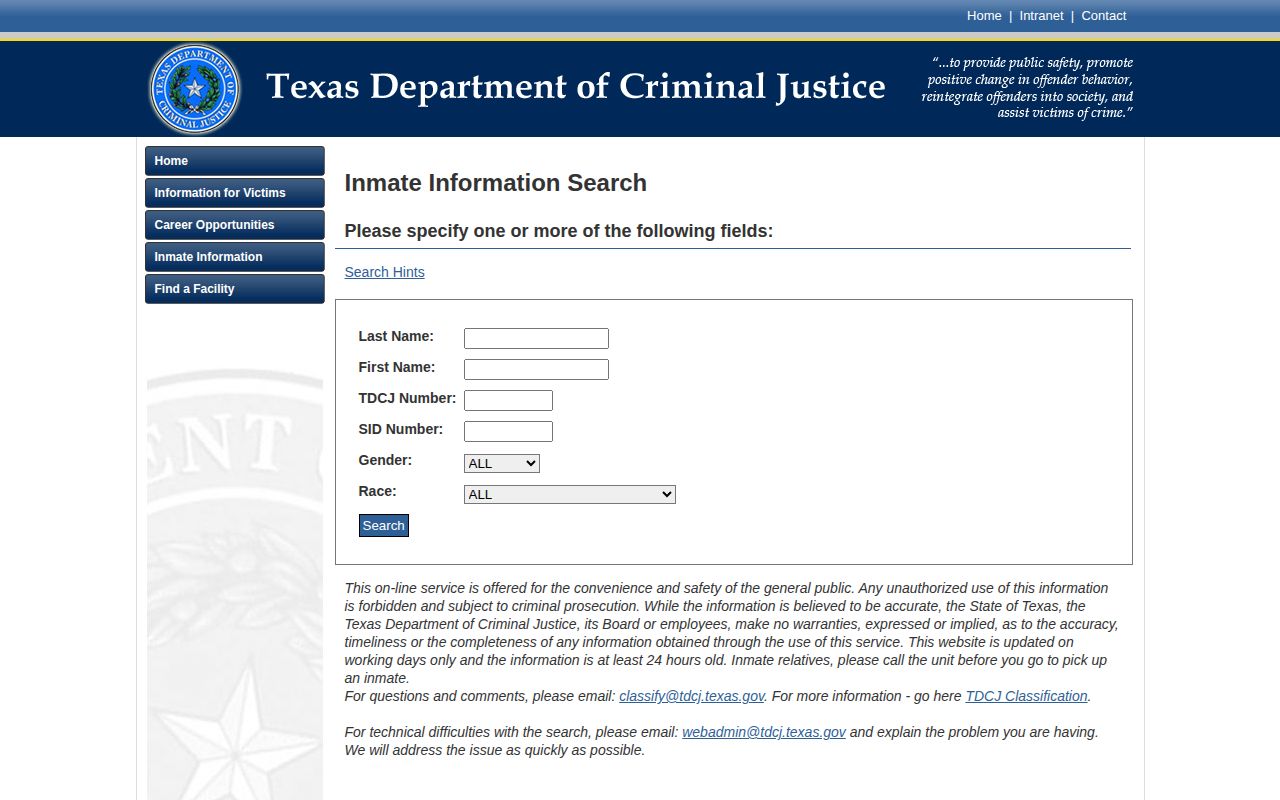
Its identifier fields are the starting point for finding the correct Texas prison record before interpreting dates.
Texas Good Time Release Clocks
Texas does not use one simple formula for every sentence. The research identifies three distinct clocks: maximum sentence expiration, parole eligibility, and mandatory-supervision eligibility. Offense date, offense type, sentence, calendar time, and the governing statute decide which branch applies. TDCJ good-conduct time is a classification and release-calculation tool. It does not erase the sentence or provide a vested right to release.
Texas Government Code Chapter 498 governs good conduct in TDCJ. Section 498.003 states that good-conduct time applies to eligibility for parole or mandatory supervision, as provided by law, and does not otherwise reduce the sentence. Classification changes and discipline can alter credits. Under Government Code §508.147, eligible mandatory-supervision calculations may compare calendar time plus accrued good time with the sentence term, subject to exclusions and discretionary review.
There is no blanket Texas “85 percent rule” for all state prisoners. Some offenses have stricter calendar-time rules. For many offenses listed in Code of Criminal Procedure Article 42A.054, Government Code §508.145(d) generally requires actual calendar time equal to half the sentence or 30 years, whichever is less, without good-conduct credit toward that eligibility calculation and subject to its minimum. Other offenses and dates follow other subsections. Applying a universal percentage would be unsupported.
Note: Eligibility permits consideration; it is not a scheduled release date or proof that release occurred.
Why Henderson Release Dates Change
A calculation can move because the underlying record changes or because an approved release still needs operational work. The TDCJ Independent Ombudsman describes a common release-certificate audit as taking about 14 to 21 business days, while warning that the scheduled date may change without notice. That timeframe is not a guarantee for every case.
| Factor | Possible effect |
|---|---|
| Discipline or classification | Changes good-conduct credit or earning status |
| Sentence or time-credit correction | Recalculates one or more displayed dates |
| BPP denial or later review | Leaves the person confined and sets another review path |
| Favorable parole vote | Starts or advances release processing, but does not prove departure |
| Required program or special condition | May delay release until completed or arranged |
| Residence plan | Must meet approval and county-of-residence rules |
| Detainer or bench warrant | May produce a transfer to another authority |
| Court order | Can alter the legal basis or timing of custody |
Record corrections also matter. Preserve a dated copy of the displayed result, then compare later records. If a date changes, ask TDCJ Classification and Records about inmate time and release at 936-437-6231 or classify@tdcj.texas.gov.
Confirm Henderson Actual Release
For TDCJ custody before a BPP vote, call 844-512-0461. After a favorable vote, call Parole Division release status at 512-406-5202. General location and status are available at 936-295-6371 or 800-535-0283 during published weekday hours. Callers need a TDCJ or SID number or exact date of birth.
TDCJ also accepts a free email inquiry at pia@tdcj.texas.gov. Include the full name and seven-digit TDCJ number, or exact date of birth when the number is unknown. An inquiry may request current incarceration information and the Projected Release Date. For an archival record, request the public portions of the incarceration history, release certificate, actual date, release mode, and supervision or discharge status.
A pending-event alert adds timely notice but does not replace the record. Current county notification uses VINELink Release Check through Texas IVSS-Counties; state-prison notification requires separate TDCJ IVSS registration. Compare the alert with the post-event TDCJ status or Henderson County release record.
Henderson County Jail Date Limits
A pretrial detainee's exit depends on court and jail events, not a TDCJ projected date. Bond may authorize release, but processing and any other hold still must be resolved. Henderson County's official Bail Bond Board confirms local bond administration, yet the reviewed official material gives no universal bond schedule or promised bond-out clock.
A county sentence should be read from the signed judgment, jail calculation, and booking/release record. Local jail time, credit for time already served, and court orders should not be estimated with a TDCJ prison formula. If a county roster entry disappears, call the jail and follow the named receiving agency. A TDCJ institutional location proves transfer to state custody rather than community release.
Build a Henderson Release Timeline
Keep a compact evidence chain: identity numbers, conviction county, offense and sentence, every labeled date, the last BPP action, the scheduled location, the later custody status, and the actual release record. Mark estimates and future dates as such. Do not merge a parole eligibility point with a board action or a scheduled operational date.
If the person fully discharges and later disappears from the live TDCJ result, request the history or certificate. If a Henderson County record and state record conflict, ask each custodian to clarify its own entry. The dated responses show which agency controlled custody at each stage.
A useful timeline starts with the sentence and offense date because those facts select the statutory branch. Next come credited jail time, the parole eligibility date, any mandatory-supervision calculation, and the maximum sentence date. Add each BPP action without turning a review date into a release date. If the board approves release, record required programs, residence-plan status, special conditions, the release certificate, and the scheduled location. Finish with evidence from after the event.
The location field is as important as the date. Movement from Henderson County Jail to a named TDCJ unit shows continued confinement. Movement from a TDCJ unit to parole or mandatory-supervision status supports community release under supervision. A detainer may instead send the person to another county, federal custody, or immigration custody. Therefore, an actual exit from one facility does not answer where the person went unless the destination is preserved.
When calling, separate calculation questions from board questions. Classification and Records handles inmate time and release calculations. BPP handles the review action before a vote. Parole Division handles release processing after a favorable vote. The Athens District Parole Office concerns a person assigned to Henderson County after release. Calling the office tied to the stage produces a clearer answer and avoids treating a board approval as a completed physical release.
Written requests should seek existing records rather than demand a new calculation. Include full identity information, a TDCJ or SID number, conviction county, and a focused date range. Ask for the incarceration history and release certificate when the actual event is at issue. Ask for clarification if the dates were corrected. Preserve the agency's response with the online capture so later changes can be explained without relying on memory.
Board vote codes need the same literal treatment. A favorable code may direct release after a program, approve a later date, or impose conditions. A denial can state reasons and a later review period. The official BPP vote-options source controls those meanings. Do not translate every approval to “release granted today.” Instead, record the code, decision date, conditions, and next operational step. Then watch for the certificate and Scheduled Release Date.
Mandatory supervision is also distinct from parole. Eligibility may depend on calendar time plus good-conduct time, but statutory exclusions and discretionary review can apply. A projected date based on one calculation branch does not ensure mandatory release on that day. Check the offender detail and governing law for the specific offense date. When the record shows parole or mandatory-supervision status after the event, state which one appears rather than grouping both as an unconditional discharge.
For county custody, a bond amount or docket entry is not a countdown clock. Payment, verification, paperwork, other cases, and detainers can affect the actual exit. The reviewed Henderson County materials publish no guaranteed release-processing time. Families arranging transportation should confirm status directly before traveling. An official rural transit resource exists, but no reviewed source establishes a jail stop, release shuttle, or same-day pickup. That service should be treated only as a lead for transportation planning.
Finally, preserve uncertainty when a source is silent. If TDCJ displays no scheduled date, report that no scheduled date was shown at the time checked. If Henderson County supplies a disposition code without a destination, ask for clarification. If a future date changes, update the timeline rather than deleting the earlier capture. This method shows how the estimate evolved and keeps the actual release distinct from every forecast that came before it.
Public Record Search
Sponsored Results